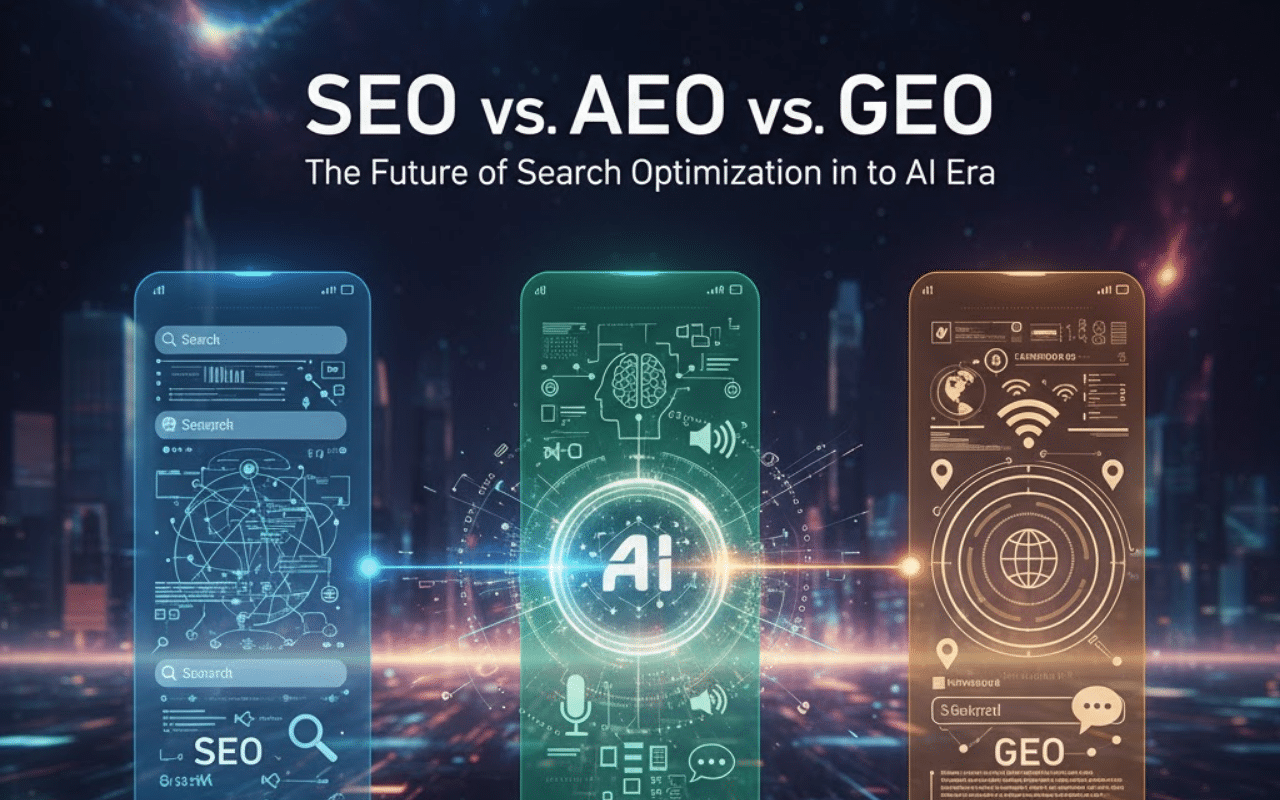
SEO vs AEO vs GEO: The Future of Search Optimization in the AI Era
Introduction
Search has never been static. From the early days of keyword stuffing in the 2000s to today’s AI-driven queries, search engines continue to evolve—and businesses must evolve with them and along research and finding new optimization we stumbled upon the question of SEO vs AEO vs GEO, which is better?
Traditionally, SEO (Search Engine Optimization) was the foundation of online visibility. But with the rise of voice assistants, AI chatbots, and generative AI search engines, two new branches emerged: AEO (Answer Engine Optimization) and GEO (Generative Engine Optimization).
These three optimization methods—SEO vs AEO vs GEO—represent different approaches to ranking in a digital world that’s moving beyond the classic search engine results page (SERP).
In this article, we’ll break down the differences, explore modern techniques, and highlight how businesses can leverage all three strategies to dominate in Google, Bing, ChatGPT, and beyond.

What is SEO (Search Engine Optimization)?
At its core, SEO is about improving website visibility in search engines like Google and Bing. The goal: to appear on the first page for relevant search terms, bringing in organic traffic.
According to BrightEdge research (2024), organic search drives 53% of all trackable web traffic, making SEO the most powerful long-term marketing channel.
Core Pillars of SEO
- Keyword Optimization → Targeting phrases with high search intent.
- On-Page SEO → Title tags, meta descriptions, internal linking, content structure.
- Off-Page SEO → Backlinks, brand mentions, authority building.
- Technical SEO → Site speed, mobile-first indexing, crawlability.
Modern SEO Techniques
1. Semantic Search & NLP
Google’s algorithms (like BERT and MUM) now interpret search intent instead of just matching keywords. For instance, searching “best laptops for students 2025” brings results optimized for context and purpose, not just raw keywords.
2. Mobile-First Indexing
Over 63% of Google searches happen on mobile (Statista, 2024). Sites optimized for mobile-first indexing rank higher.
3. AI-Powered SEO Tools
Platforms like Surfer SEO, SEMrush, and Ahrefs leverage AI to suggest optimization strategies, cluster keywords, and track SERP volatility in real time.
SEO remains the foundation—but AI is forcing it to evolve.

What is AEO (Answer Engine Optimization)?
AEO is about optimizing content for direct answers instead of web page clicks. This is especially important in voice search and AI-powered assistants.
Example:
- If you ask Siri: “What is the tallest building in the world?” you don’t get a list of links—you get a direct spoken answer.
Why AEO Matters
- Over 50% of online searches are voice-based (Comscore).
- Featured snippets (answer boxes) get 2x higher click-through rates compared to regular organic results.
Techniques for AEO
1. Schema Markup
Structured data helps search engines understand your content. For example, a recipe site can use schema to show cook times, calories, and ratings directly in results.
2. FAQ Optimization
Adding Q&A sections makes content more likely to appear in Google’s People Also Ask and voice results.
3. Conversational Keywords
Instead of “best Italian restaurant,” people ask, “Where can I find the best Italian restaurant near me?”
AEO tailors content for these natural, conversational queries.

What is GEO (Generative Engine Optimization)?
GEO is the newest form of optimization—focused on generative AI engines like:
- Google AI Overviews (rolled out 2024–2025)
- ChatGPT (with browsing)
- Perplexity AI
- Microsoft Copilot
Instead of showing a ranked list, these platforms generate full answers based on multiple sources.
Why GEO is a Game-Changer
- According to Gartner (2024), by 2026, 30% of all search queries will be handled by AI-powered generative engines.
- Websites that fail to optimize for GEO risk disappearing from AI-driven answers, even if they rank high on Google.
GEO Optimization Strategies
1. Build Authoritative Content Clusters
LLMs like ChatGPT pull from topic clusters rather than isolated articles. For example, if your site has 10 interlinked articles on “AI in marketing,” your chances of being cited rise significantly.
2. Train AI with Trust Signals
LLMs prioritize E-E-A-T (Experience, Expertise, Authoritativeness, Trustworthiness). Adding expert authorship, citations, and transparency boosts inclusion.
3. Monitor AI-Generated Rankings
Tools like NeuronWriter, Surfer SEO, and even Perplexity analytics help businesses track if their site is being cited in AI-generated answers.
GEO is not about keywords only—it’s about shaping AI’s “knowledge base”.

SEO vs AEO vs GEO – Key Differences
Here’s a comparison table:
| Feature | SEO | AEO | GEO |
| Focus | Ranking in SERPs | Answer boxes & voice search | AI-generated answers |
| Main Platforms | Google, Bing | Google Assistant, Alexa, Siri | ChatGPT, Perplexity, AI Overviews |
| Content Style | Optimized blogs, pages | FAQs, conversational | Deep authoritative clusters |
| Ranking Signals | Keywords, backlinks, site speed | Schema, structured data | E-E-A-T, citations, AI trust |
| Example Query | “Best smartphones 2025” → list of blog posts | “What is the best smartphone in 2025?” → one spoken answer | “Best smartphones 2025” → AI-curated answer with sources |
Which Strategy Should Businesses Prioritize?
For Local Businesses
- SEO ensures you rank in local search results.
- AEO helps voice assistants find your business (e.g., “best dentist near me”).
For E-Commerce
- GEO is crucial: generative engines recommend products directly.
- SEO remains important for category pages.
For Content Creators & Blogs
- Blend all three:
- SEO → Long-tail traffic.
- AEO → Snippets & FAQs.
- GEO → LLM-driven visibility.

Future of Search – Convergence of SEO vs AEO vs GEO
The future isn’t about choosing one strategy or debating between SEO vs AEO vs GEO —it’s about integrating all three.
- AI SEO Optimization → Traditional SEO enhanced by AI tools.
- AEO → Voice and snippet dominance will continue as more devices rely on natural conversation.
- GEO → LLM-driven search engines (ChatGPT, Gemini, Perplexity) are already replacing traditional queries for millions of users.
Businesses must future-proof by diversifying optimization strategies across all three.
Conclusion
SEO is still the foundation. AEO builds on it by targeting direct answers. GEO pushes further, ensuring your content shows up in AI-generated responses.
The winners of tomorrow’s digital economy will be those who adapt early:
- Create SEO-friendly content.
- Optimize for voice and answer engines.
- Build authority for AI-driven generative search.
Final advice: Don’t abandon SEO—but start building for AEO and GEO today. The future of search won’t be one-dimensional. It will be SEO + AEO + GEO working together.










Post Comment