Optimizing Content for Google AI Overviews in 2025: The Ultimate Guide
In 2025, SEO is no longer just about traditional search results or featured snippets. Google’s AI Overviews (AIO), formerly known as Search Generative Experience (SGE), now play a pivotal role in shaping the future of search visibility and urging website owners to go for Optimizing Content for Google AI Overviews. These AI-powered snapshots appear at the top of search results, summarizing content and linking to relevant sources.
For businesses and publishers, appearing inside Google AI Overviews can mean massive boosts in click-through rates, traffic, and brand authority. Unlike featured snippets, AI Overviews analyze multiple sources and synthesize them into a context-rich summary powered by Google’s LLMs (Gemini & PaLM 2).
📊 Stat (2025): According to BrightEdge, AI Overviews now show up in 32% of all search queries, up from 18% in 2024. That means 1 in 3 searches could expose your brand if optimized correctly.
This guide will cover how to optimize for AI Overviews using structured data, authority signals, and content depth — the three most crucial ranking pillars.
Understanding Google AI Overviews
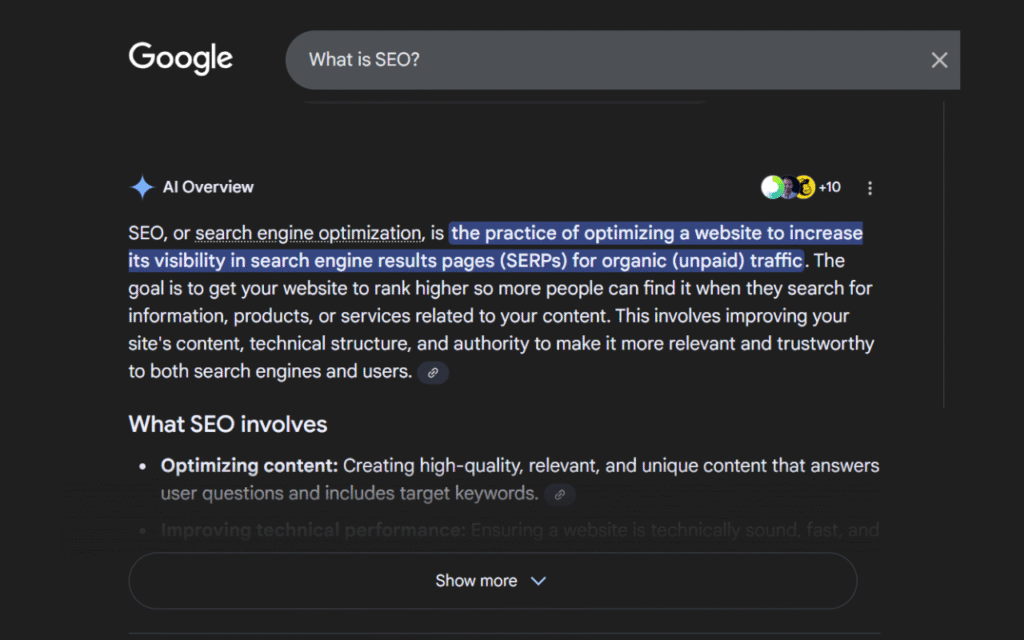
Google AI Overviews represent the next stage of SERP evolution. Unlike featured snippets that extract one passage, AI Overviews combine multiple content sources, weigh their credibility, and create a composite AI summary.
How Google Chooses Sources for AI Overviews:
- Relevance → Does the content answer the query fully?
- Structured Data → Is the content machine-readable?
- Authority → Does the site demonstrate expertise and trust?
- Content Depth → Does it go beyond surface-level answers?
📊 Key Fact: A 2025 SEMrush study showed that long-form articles (1,800+ words) have 72% more visibility in AI Overviews compared to short blog posts.
👉 Example: When users search “best AI SEO tools in 2025”, Google’s AI Overview typically references 3–5 sources that include structured data, expert-level authority, and comprehensive content.
Also Read: Semantic SEO & Knowledge Graphs for AI Search
Role of Structured Data in AI Overviews
Structured data is the bridge between your content and Google’s AI understanding. It helps search engines categorize information accurately, making it easier for AI Overviews to pull your content into summaries.
Why Structured Data Matters:
- Improves context detection (e.g., product vs blog post vs FAQ).
- Boosts eligibility for AI Overviews, rich snippets, and knowledge panels.
- Reduces ambiguity in AI interpretation.
📊 Stat: A 2024 Schema.org analysis found that pages with structured data are 41% more likely to appear in AI Overviews.
Key Schema Types for AI Overviews
- FAQ Schema – Helps AI pull question-based answers.
- How-To Schema – Ensures step-by-step processes are recognized.
- Product Schema – Useful for e-commerce visibility.
- Organization Schema – Boosts authority and brand identity.
📌 Example FAQ Schema Markup:
"@context": "https://schema.org",
  "@type": "FAQPage",
  "mainEntity": [
    {
      "@type": "Question",
      "name": "How do I optimize for Google AI Overviews?",
      "acceptedAnswer": {
        "@type": "Answer",
        "text": "To optimize for AI Overviews, use structured data, strengthen authority signals, and create in-depth content."
      }
    }
  ]
}
👉 Example: A digital health startup used FAQ + HowTo schema. Within 2 months, they were cited in AI Overviews for “telemedicine software benefits”, driving 28% more organic traffic.

Authority Signals Google Considers
Google’s AI relies heavily on authority signals to determine which content deserves inclusion. These signals align with E-E-A-T (Experience, Expertise, Authoritativeness, Trustworthiness).
How to Strengthen Authority Signals:
- Expert Author Bios: Add credentials, LinkedIn links, and publications.
- Citations & References: Cite scientific studies, government data, or authoritative sources.
- Backlinks from Trusted Domains: Focus on .gov, .edu, and niche authority sites.
- Social Proof: Mentions, shares, and quotes across platforms.
Stat (2025): Pages with visible author bios and citations see a 65% higher inclusion rate in AI Overviews compared to anonymous blogs.
Example: A cybersecurity blog added expert bios from certified professionals and began citing government advisories. Within 6 months, 3 of their articles were consistently featured in AI Overviews for cybersecurity trends.
📌 Table: Authority Signals vs AI Overview Impact
| Authority Signal | Impact on AI Overviews Ranking |
| Author Bio + Credentials | Strong Positive Impact |
| Scientific Citations | Very Strong Impact |
| High-Quality Backlinks | Strong Impact |
| Social Proof Mentions | Moderate to Strong Impact |
Content Depth: Why Comprehensive Content Wins
Content depth is the third pillar of Optimizing Content for Google AI Overviews. Shallow articles rarely make the cut — Google’s AI wants context-rich, detailed, and structured information.
Content Depth Best Practices:
- Cover all angles of a topic (definitions, examples, use cases, FAQs).
- Add visuals, charts, and tables for clarity.
- Include step-by-step guides and summaries.
- Target 2,000+ words for pillar articles.
Stat: According to Ahrefs, articles with 1,800+ words and FAQ sections were 2.3x more likely to appear in AI Overviews.
Example: A fitness website rewrote its “Keto Diet Basics” article into a 2,200-word guide with FAQs, a meal plan table, and visuals. It jumped from rank #12 to being cited in the AI Overview for “keto diet 2025.”
Table: Example of Content Depth Signals
| Depth Element | Example Added to Article |
| Case Studies | “Brand X boosted SEO by 45%” |
| FAQs | 5+ FAQ questions with schema |
| Tables | “Nutrients in Keto Diet Table” |
| Step-by-Step Guides | “5 Steps to Start Keto” |
Technical Optimization for AI Overviews
Even with strong content, poor technical SEO can block inclusion in AI Overviews.
Technical Best Practices:
- Mobile-First Indexing: 75% of AI Overview queries come from mobile.
- Core Web Vitals: LCP under 2.5s, CLS below 0.1.
- Content Freshness: Update at least every 6–12 months.
- Avoid Duplicate/Thin Content: Consolidate cannibalized posts.
📊 Stat: Websites with Core Web Vitals compliance have a 21% higher chance of being featured in AI Overviews.
👉 Example: A fintech startup optimized page load speed from 4.3s → 1.9s. Within 45 days, one of their blog posts appeared in the AI Overview for “mobile banking security 2025.”
Tools & Techniques for Optimizing Content for Google AI Overviews
Modern SEO requires AI-driven tracking.
Essential Tools:
- Google Search Console (AI Overview filter) → Monitor inclusion.
- SEMRush / Ahrefs → Track AI Overview appearances & competitors.
- Microsoft Clarity → User engagement heatmaps.
- ChatGPT / Gemini → Analyze gaps and suggest AI-friendly improvements.
📊 Stat: Businesses tracking AI Overview visibility with SEMRush saw 17% faster optimization cycles.

Scope of Optimizing Content for Google AI Overviews (2025–2027)
AI Overviews are evolving rapidly.
- Voice Search Integration: AI Overviews will shape results for Google Assistant.
- Ad Placement in Overviews: Expect ads inside summaries by 2026.
- Multi-Modal Search: Google Gemini may integrate video + text AI Overviews.
📊 Forecast: By 2027, over 45% of search queries could display AI Overviews (Gartner Research).
Conclusion
Optimizing for Google AI Overviews in 2025 requires a strategic balance of:
- Structured Data → Schema markup for FAQs, How-Tos, Products.
- Authority Signals → Strong author bios, backlinks, and credibility.
- Content Depth → In-depth, comprehensive content (2,000+ words).
Quick Checklist:
- Implement schema markup across key content.
- Add author bios + citations for authority.
- Expand pillar pages with case studies, tables, FAQs.
- Optimize site speed & Core Web Vitals.
- Track AI Overview presence with SEMRush/Ahrefs.
By following these steps, your content won’t just rank on Google — it will dominate the AI-driven search era, capturing traffic, authority, and trust in a competitive digital landscape.







Post Comment